
Balinese Kotèkan Types

Further study on this subject: Ancient Traditions–Future Possibilities:
Rhythmic Training Through the Traditions of Africa, Bali and India.
By Matthew Montfort. Ancient Future Music (1985).
ISBN 0-937879-00-2. Book/CD Set- 74.95. SALE! $53.95:
Add Book/CD to Cart. Buy Book/CD Now.
30 Minute Online Lesson.
Custom private lesson via Zoom or other service. $55. SALE! $44:
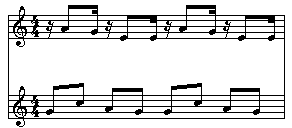
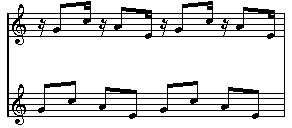
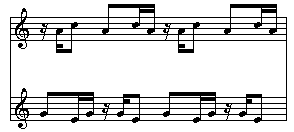
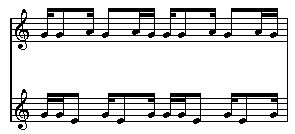
The interlocking kotèkan rhythms of Bali are divided into two parts known as nyangsih (male) and polos (female). In all of the examples below (from Ancient Traditions–Future Possibilities, Chapter 2, Exercise II, page 49), the polos part is on the bottom staff while the nyangsih part is on the top.
There were four types of melodic kotèkans that were recognized in North Bali by Music in Bali, Colin McPhee's ground breaking documentation of Balinese music in the 1930's: chandetan, tutugan, ochètan, and semi-ochètan. Modern Balinese music scholarship seems to be coalescing around another set of terms, but these four types serve as a good starting point for study in the musicianship required to perform interlocking rhythms.
Chandetan

The chandetan is an alternating rhythm in which the nyangsih melody differs from the polos:
Tutugan
The tutugan is an alternating rhythm in which the nyangsih melody follows the polos:
Ochètan
The ochètan is an interlocking rhythm in which two separate voices are created where the parts meet:
Semi-Ochètan
The semi-ochètan is an interlocking rhythm in which the parts meet on a unison:
Further Resources
Ancient Rhythms–Future Grooves
Ancient Rhythms–Future Grooves: Audio and MIDI Percussion Groove Tracks from the Traditions of Africa, Bali, and India. Want more audio and MIDI files? Get this complete collection of groove tracks from the book Ancient Traditions–Future Possibilities. For a limited time, get both the book and the enhanced audio CD set with MIDI files for only $53.95 (SALE! Normally $74.95): Add 1 to Cart. Buy 1 Now.
Skype School => Zoom Room

Further instruction on this material is available through private Zoom lessons with the author, Matthew Montfort.