Do You Know . . .
|
Origins
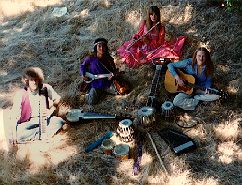
Ancient Future was formed in 1978 by students at the Ali Akbar College of Music in San Rafael, California, including Mindia Klein, Matthew Montfort, Benjy Wertheimer, and Phil Fong. Its origins, however, go back to 1967. Two of the founding members, Matthew Montfort and Benjy Wertheimer, were childhood friends in Boulder, Colorado, who dreamed of forming a band together. By his senior year of high school, Montfort was playing guitar professionally in several local bands. Meanwhile, Wertheimer had gravitated to percussion and Indian tabla drums in particular. A friend of Wertheimer's introduced Montfort to a record by the Diga Rhythm Band, which featured North Indian tabla master Zakir Hussain and his students along with Grateful Dead drummer Mickey Hart and guitarist Jerry Garcia. Montfort was fascinated by Indian rhythms, and decided to integrate them into his jazz/rock/classical fusion music. In the summer of 1977 Wertheimer and Montfort came to San Rafael to study North Indian classical music at the Ali Akbar College of Music. There they met the members of the Diga Rhythm Band, moved into the house that the group rehearsed in, and formed an offshoot called Greenhouse Intergalactic, which included Diga Rhythm Band members Tor Dietrichson (who later signed with Global Pacific Records), Jim Loveless, Ray Spiegel, and Arshad Syed (who joined Ancient Future's touring lineup in 1993). Greenhouse Intergalactic rehearsed at the Grateful Dead studio and performed a number of concerts before splitting up into two groups: a Latin band called Sun Orchestra, and the world fusion music group Ancient Future. So, Ancient Future can be thought of as an offshoot of an offshoot of an offshoot of the Grateful Dead:
The first lineup of Ancient Future included Mindia Klein on flute; Phil Fong on sarod, guitar, and zither; Benjy Wertheimer on tabla and esraj; and Matthew Montfort on guitar and sitar. None of these musicians were ever really quite Deadheads. But if the Diga Rhythm band hadn't been created by Zakir Hussain, Mickey Hart, and company, Ancient Future may never have formed. Besides, we have to have some names of famous 60's pop icons to drop, don't we? Then again, we could have used The Beatles:
OK, so maybe this is getting a little ridiculous. But there is no excuse for boring Ancient Future history! |
Naming Ancient FutureMany have asked how the name Ancient Future was selected, perhaps
expecting a mystical answer incorporating quantum physics and
Eastern philosophy. The truth is that during the group's "name
the band" brain storming sessions, two apparently contradictory
themes emerged. Sarodist Phil Fong was very interested in the
legendary ancient civilizations of Atlantis and Mu, and liked
to imagine what the music of Mu might have been like. Fong envisioned
a band name invoking an image of the ancient civilizations where
the world's great musical traditions were born. But the group
also wanted its name to express a vision of hope for the future
through the cross-cultural exchange of that ancient knowledge.
Thus the name Ancient Future was born. Those who were expecting the quantum physics explanation should now exit Ancient Future history via this alternative gateway to the Ancient Future from another parallel universe. Time travel is a lot more fun than the truth. No "s"New fans of the world fusion music ensemble Ancient Future often mistakenly add an "s" at the end of the name. When faced with this band members reply in jest that Ancient Futures are expired stock certificates. It has even been suggested that Ancient Future go public one day and issue ancient futures (your feedback on this hair-brained scheme is welcomed at the Ancient Future guest book). Actually, in light of David Bowie's much publicized stock offering, this scheme is looking less hair-brained all the time! |

World Fusion MusicWhen Ancient Future created its own contemporary sound by combining elements of the world's ancient music traditions, no one quite knew what to call the end result. In 1978, Ancient Future coined the term world fusion music to describe a genre which blends musical ideas from many different traditions.1 Today, the expanding popularity of world music merits its own sales chart in BILLBOARD. The world fusion music movement that Ancient Future envisioned has blossomed. Some evidence of this growth can be seen on Ancient Future's World Fusion Music Link Page. 1Stephen Hill, Guide to C.T.I.S. Music, (San Francisco: Hearts of Space Press, 1981), 36. |
First RecordingIn December, 1978, Montfort, Wertheimer, Klein and Fong went into Tres Virgos Studio in Mill Valley to record Montfort's song Moonbath. The song became the springboard for the first Ancient Future record, Visions of a Peaceful Planet, which includes five other songs. The record was financed by the group and recorded for under $2500. In May 1999, Visions of a Peaceful Planet was reissued as an Internet only release. The first MP3 song from the reissue, Eternal Embrace, was the Internet's #1 World Music song (1999 mpulse.com tracking). Tres Virgos Studio later moved to San Rafael and was sold to producer Narada Michael Walden, who, despite popular misconception, has absolutely nothing to do with Ancient Future's current record label, Narada Records. Visions of a Peaceful Planet (Ancient-Future.Com AF-79)
|
First ConcertAncient Future's first concert took place to a packed house on February 11, 1979, at the Sleeping Lady Cafe in Fairfax, California. The Sleeping Lady was a vegetarian cafe and music club co-op that was the center of a vibrant local music scene. In the mid 80's, the co-op was seized by a punk rock aesthetic. Somehow, punk rock music and vegetarian hippy food did not prove to be a winning business combination, and the club went belly up. |
The Natural Rhythms Period
The concept for the Natural Rhythms record grew out of a magical spontaneous recording session at a friend's recording studio near a frog pond. When Montfort and Klein noticed the sound of croaking frogs leaking into the studio, they were inspired to record them. Montfort went out to the pond with a zither and began to play. He found that certain rhythms produced musical responses. The music recorded that night was very magical, and eventually became part of the Natural Rhythms album. Several months later, Montfort and Klein went to Bali to study gamelan music. They were amazed to find paintings all over the island portraying Balinese rice paddy frogs playing gamelan instruments. They saw dances imitating the frogs and heard music imitating the frog calls. Montfort and Klein decided to extend their musical experiments to include the Balinese rice paddy frogs. Late at night, they gathered their musical Balinese friends, went out into the rice paddies, and jammed with the frogs. Again, some very magical moments of music transpired. The tapes were taken back to San Francisco, transferred to multitrack tape, and became part of the Natural Rhythms recording. The Cover Painting
While in Bali, they became very close friends with an amazing Balinese painter named Nyomen Kawiana and his brother, Wayan Ludra. Nyomen Kawiana was inspired to do some paintings depicting frogs playing the instruments of Ancient Future's world music ensemble. He spent three months working on them, and then presented the paintings to his American friends as a gift. He refused payment, since according to his religion, his family would be repaid for his good deed in other ways. Montfort later found out that this did indeed happen. The record turned out to be a milestone for the group, garnering N.A.I.R.D. "Indie" awards in World Music and Album Cover Design. Epilog: 1986 Oregon Country FairMany years after recording Natural Rhythms, Matthew Montfort and Benjy Wertheimer were invited to perform a duet at the 1986 Oregon Country Fair in Eugene. After their performance, Montfort was surprised to be greeted by a Balinese man. After all, it would take a typical Balinese villager an entire life's savings just to buy a plane ticket to America. On closer inspection, the Balinese man would turn out to be none other than Wayan Ludra, the brother of Natural Rhythms cover artist Nyomen Kawiana. What was he doing in America? It turned out that an Oregonian named Sandra Barger had purchased a copy of Natural Rhythms and fallen in love with it. She had an import/export business that took her to Bali. She was walking through the village of Pengosekan when she heard Natural Rhythms coming from a home. She was quite curious how they came to have a copy of the record and went up to investigate. She met Wayan Ludra and Nyomen Kawiana and was told the story of their American friends who liked to play music with frogs. On this basis quite a connection was made, and she became great friends of the family, later marrying Wayan. She established her business in Bali at the family compound, and brought the whole family great wealth. Nyomen's generosity had come full circle, and had even produced a meeting in America for Wayan and Montfort. Natural Rhythms (Philo/Rounder 9006)
|
The Transition Period
After Natural Rhythms, Phil Fong joined a punk rock band and was unavailable for touring. In August and September 1981, Matthew Montfort, Benjy Wertheimer and Mindia Klein toured the US Not long after the tour, Klein left Ancient Future and was replaced by Randy Mead (flutes) and Rick Henderson (sarod). After several tours Henderson left the group and was replaced by Marcia Sloane on cello. |
The Quiet Fire PeriodOn the next Ancient Future record, the group focused on a world chamber music concept featuring flute, cello, classical and scalloped fretboard guitar, esraj, tabla and charango. Guest artists Alex De Grassi and Darol Anger of Windham Hill performed on the record. Following the recording of a self-produced master tape that was shopped to various labels, Narada Records made an offer that included an opportunity to record a second uptempo album as a follow up. Montfort was excited by the prospect of a more uptempo record, and accepted the offer. The first record was released under the title Quiet Fire. About that time, Wertheimer and Mead formed a pop vocal band with their wives, and Sloane returned to her classical cello career. Montfort recruited Ian Dogole (percussion), Doug McKeehan (keyboards), and Bruce Bowers (violin, flute) to form a new version of Ancient Future with a jazzier sound. Quiet Fire (Narada/MCA 1012)
|
The Dreamchaser Period
When Narada offered more artistic freedom on a new label they were starting called Sona Gaia, it was gladly accepted. Ancient Future recorded two of its very best releases for this label. Although the Sona Gaia label had a minuscule advertising budget, the records were strong sellers nonetheless that succeeded on their own merits. The first Sona Gaia release, Dreamchaser, showcased some of the jazzier side of Ancient Future's world fusion music. The record debuted at #2 on the May 1989 JAZZIZ National Airplay chart. It received a 10 out of 10 rating in CD REVIEW. Dreamchaser (Sona Gaia/MCA 154)
|
The World Without Walls Period
In August of 1988, violinist Jim Hurley replaced Bruce Bowers. The resulting line up remained the same for over 7 years. After several tours on the West Coast, the group began working on its next release, World Without Walls. It features performances by Zakir Hussain, the master of the North Indian tabla. Working with Zakir Hussain brought the group full circle from its 1978 origins out of the musical scene surrounding Hussain's percussion group, the Diga Rhythm Band. World Without Walls (Sona Gaia/MCA 163)
|
The Asian Fusion Period
At the end of an Ancient Future performance at the 1991 Sacramento River Jazz Festival, Matthew Montfort was introduced to China's top gu zheng (Chinese zither) master, Zhao Hui, by her husband, Shen Hsu. Montfort was invited over for dinner, and afterwards Ms. Zhao played. He was so captivated by what he heard that he took out his guitar. The sound of her gu zheng blended beautifully with the scalloped fretboard guitar, and a musical chemistry was immediately apparent. This experience was the genesis for the Asian Fusion record. It inspired Montfort to further explore fusing ancient Asian and contemporary Western elements. Zhao Hui agreed to participate in Ancient Future's next set of shows. Montfort taught her some of the Ancient Future repertoire, while she taught him Dusk Song of the Fisherman (which they later recorded for Asian Fusion), an ancient Ching Dynasty theme expressing the joy of returning to the harbor at dusk, singing a happy song. When the first show began, Montfort was back stage as the crowd went absolutely wild for Zhao Hui's opening solo. For the first time in many years, he had a case of stage fright. He had been playing Chinese music for all of two days. In a few minutes, he was going to perform traditional Chinese music with China's preeminent master of the gu zheng. Would he be a let down after what she had already done? But the muse took over and they were into one of those rare moments in music when things click just right. The crowd gave them a standing ovation, and the concert tape even landed them a Touring Program grant from the California Arts Council. The Asian Fusion album concept evolved to include other guest artists. One important artist on the release is Bui Huu Nhut, a leading performer of the Vietnamese dan bao, a one string instrument with an indigenous version of a whammy bar. Montfort saw Mr. Bui at the Festival of the Lake in Oakland, and was entranced by the sound of the instrument. The two became great friends and set about finding a way to perform together. Montfort wrote a piece called Ja Nam based on a Vietnamese folk song, but with a reggae beat. Montfort was able to learn about Vietnamese melody, and Bui learned about performing with Western instruments and rhythms. That is the beauty of cross-cultural exchange -- people learning from each other and growing in the process. Asian Fusion (Narada Equinox ND-63023)
|
The Planet Jammin' Germination PeriodAfter twenty years of development, the world music scene surrounding Ancient Future flowered with collaborations between some of the world's top masters of traditional music. The Planet Jammin' concept evolved out of these collaborations on recordings and concerts. On the concert front, in 1998 Ancient Future began offering a new collaborative world music and dance series featuring top world music and dance masters such as Ustad Habib Khan (North Indian sitar master), Irina Mikhailova (Russian vocal diva), Zhao Hui (Chinese national treasure), Georges Lammam (Arabic violin virtuoso), San Jose Taiko (Japanese drums) and Sapphira (world dancer). A quick check of Ancient Future's concert schedule will reveal quite a few of these collaborations. The effect of this has been to bring even more variety to Ancient Future shows, and to provide a forum for various configurations of the ensemble from a duet on up to a 12 piece group including the world music and dance masters above. On the recording front, several projects grew out of this vibrant world fusion music scene. First to be completed were several all-star projects featuring Pandit Habib Khan, who is regarded as one of the best sitar players in the country today. He was born into a family of musicians and can trace his lineage back several generations to when classical music enjoyed the patronage of the nobility and royalty of India. He has produced three CDs featuring collaborations with Ancient Future leader and scalloped fretboard guitar master Matthew Montfort. The lineup also includes Indian tabla master Swapan Chaudhuri, jazz drummer Danny Gottlieb of Pat Methany fame, Persian santur master Alan Kushan, pianist Ira Stein of Windham Hill and Narada fame, George Brooks on saxophone, and others. |
The 20th Anniversary PeriodIn 1999 Ancient Future celebrated 20 years of world fusion music. February 11, 1999 was the 20th Anniversary of the first Ancient Future concert, and was celebrated with a chat cave event featuring original members of the group. A 20th anniversary concert featuring both the original and current groups occurred March 21st at the Freight and Salvage in Berkeley, California. May 1999 was the 20th Anniversary of the cassette release of the first Ancient Future recording, Visions of a Peaceful Planet, and was celebrated with the release of a sneak preview song from the latest Ancient Future recording on the May 1999 Rhythm Magazine CD Sampler, along with the internet-only release of Visions of a Peaceful Planet on CD-R. |
The Independent PeriodThe seventh Ancient Future record, Planet Passion, is a very ambitious project featuring the full Planet Jammin' lineup collaborating on the theme of music inspired by rituals having to do with love and procreation. For instance, the record takes themes from traditional music associated with love gods such as Ochun (Afro-Cuban) and Semara (Balinese) and uses that as source material for contemporary collaborations. The record began production in 1996, and was in stores starting in late 2002. A selection from the record is included on the May 1999 Rhythm Magazine sampler CD. The recording was produced by Ancient Future without financing from a record company. Instead, money was raised from fans of Ancient Future. While the fundraising total fell short of goals, enough was raised to allow the music to be created and released without pressure from a corporate record label more concerned with marketing and trends than music. Planet Passion (Ancient-Future.Com AF-2001)
|
The Internet Popularity/Piracy PeriodBy the year 2000, Ancient Future had established itself as the top world music group on the Internet. Ancient Future had taken number one positions in nine categories (World, World Fusion, Irish, Indian, Asian, Arabic, Middle Eastern, Russian, and Indonesian) on mp3.com. Ancient Future songs had been featured on many mp3 samplers from sites such as riffage.com and mp3.com with a combined distribution of 750,000 units in 1999 alone. At riffage.com, the song "El Zaffa" received top reviews in its category and was featured on barnesandnoble.com. Ancient-Future.Com was the top world music web site 1999/2000 on the mPulse Internet Music Chart, which ranks music sites by numbers of daily unique visitors. The band Ancient Future even beat The Backstreet Boys to become the number one major artist site. However, rampant free file sharing had resulted in the value of recorded music being zero in the minds of many. It was widely alleged in the media that this would be great publicity and result in more sales. But those sales never materialized for Ancient Future. For example, even legal downloads at mp3.com (which has since gone out of business), complete with "buy now" links to purchase CDs did not result in increased sales. To the contrary, only 1 in 899 legal free promotional downloads could be matched with a sale anywhere in the distribution chain. This doesn't include the many illegal downloads that also occured. Many other independent artists at mp3.com reported legal download to sales figures at more like 1 in 5000. Faced with these obstacles, in 2001, Ancient Future leader Matthew Montfort was involved as a proposed Class Representative for Independent Musicians in a lawsuit against Napster, and proposed a set of solutions to the problems facing musicians in an Open Letter sent to the Senate Judiciary Committee and Napster CEO Hank Barry on March 14, 2001, in which he advocated a statutory license for file sharing to insure that the practice could continue, but with payments to musicians. On April 3, 2001, Mr. Barry made a plea to congress with a proposal substantially similar to the one Montfort had advocated earlier. The proposal was opposed by the major record labels, and was not adopted. 2002 and 2003 were tough years for Ancient Future financially. Scores of independent record stores that had in the past carried Ancient Future's CDs went out of business, causing the other stores to be very conservative in their stocking decisions. Out of 100 stores that agreed to stock Ancient Future's Planet Passion CD, 10 went out of business in the first two months of the release. In addition to the problems in the record industry, there were severe cutbacks in arts budgets. The California Arts Council Touring Program which supported the band's touring activities in California was terminated due to state budget cuts. Many of the presenters who had sponsored Ancient Future concerts in the past were forced to severely cut back their schedules or take a hiatus. A whole new concert booking system was developed in late 2003 to deal with the emerging situation, and by late 2004 bookings were up, although by 2005/2006 further cutbacks in the arts in the USA were starting to take their toll. A new focus on international performances resulted in tours of Spain and India. In 2004, a deal was signed with an internet distribution company that resulted in getting Ancient Future's music on the legal download sites such as iTunes. In 2006, Planet Passion was released in India on Music Gallery India. Check it out at these world fusion supportive record stores, download it at sites such as eMusic.com and iTunes, and make direct purchases from Ancient-Future.Com Records, an artist coalition label.
|